
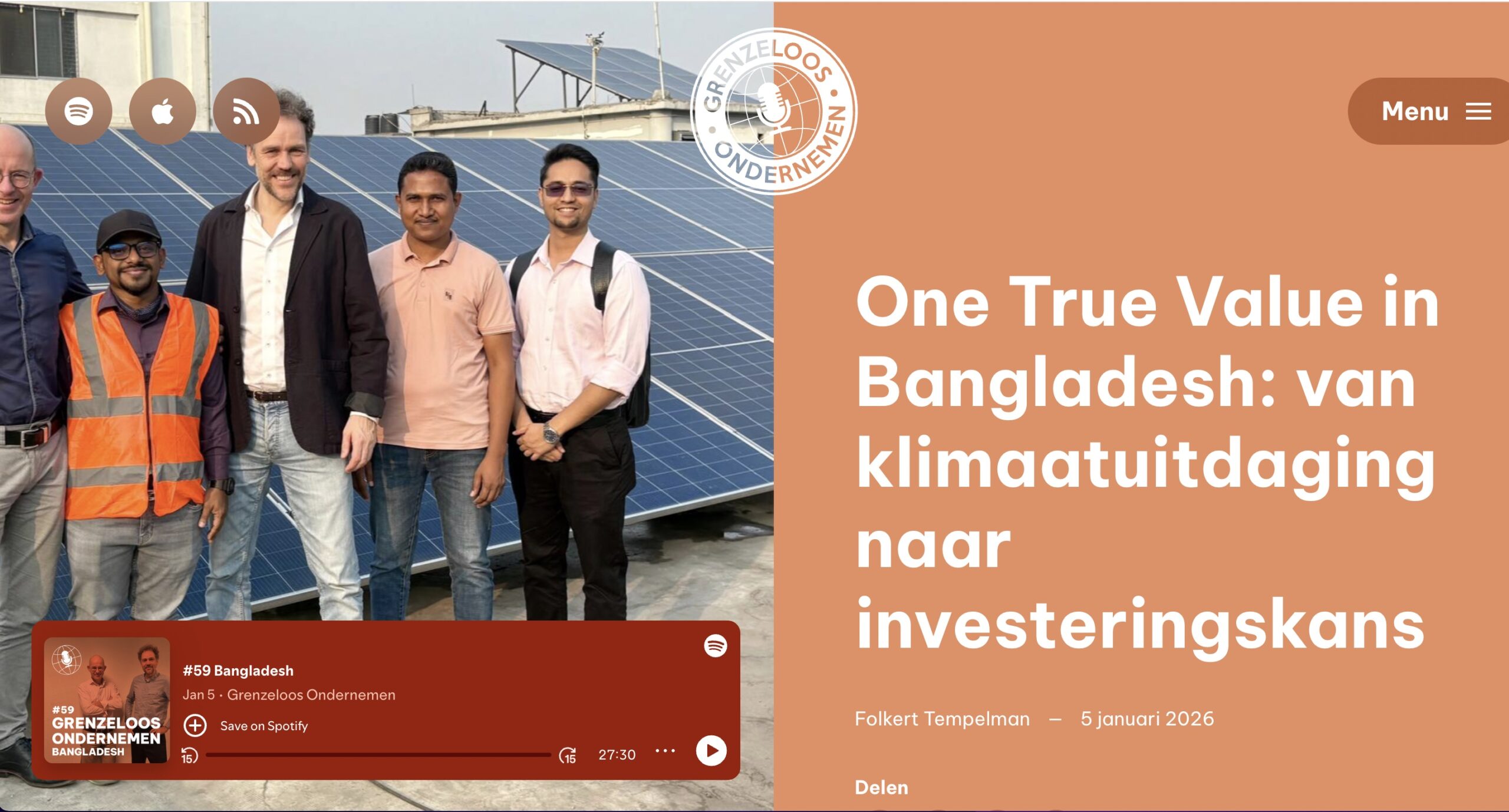
In this (Dutch) episode of Grenzeloos Ondernemen, a podcast about international business, Willem Grimminck and Jaap-Jan Verboom explain how they transform climate challenge into an investment opportunity. One True Value finances solar panels on factories through their ORE2 fund. The result: lower costs, fewer emissions and retention of crucial export contracts. A business model that could save Bangladesh and become the blueprint for all of manufacturing Asia.
From Climate Challenge to Investment Opportunity in Bangladesh
“We invested in an entrepreneur with a one-man operation. Now he employs more than 10,000 people and supplies every IKEA worldwide. That’s the power of Bangladesh,” says Jaap-Jan Verboom of Truvalu. He has been investing in the world’s most densely populated country for years. Together with Willem Grimminck from One To Watch, he founded impact investment fund One True Value. Their mission? Help factories in Bangladesh become sustainable before it’s too late.
The urgency is real. Bangladesh produces clothing for half the world. But new EU regulations are forcing clothing brands and factories to reduce CO2 emissions. No sustainability means no exports to Europe soon. And therefore no jobs in Bangladesh. While energy costs are rising and capital for greening is lacking.
In this episode of Grenzeloos Ondernemen, our podcast about international business, Willem and Jaap-Jan explain how they’re tackling this problem. They finance solar panels on factories through their ORE2 fund. The result: lower costs, fewer emissions and retention of crucial export contracts. A business model that could save Bangladesh and become the blueprint for all of manufacturing Asia.
More sun for your money
The second Off-Grid Renewable Energy investment fund, ORE2 for short, has an ambition of 50 million euros. Willem explains why this fund is necessary. “International supply chains are responsible for about sixty percent of all emissions in the world. The garment industry causes two to eight percent of those emissions. That’s really enormous. And fifty percent of all that production is in Asia.”
The problems for factories in Bangladesh are twofold. First, compliance. The European Union requires that buyers (clothing brands) purchase products made with lower emissions. Factories that don’t comply can no longer export. Second: green technology is cheaper and available. But there’s no access to capital.
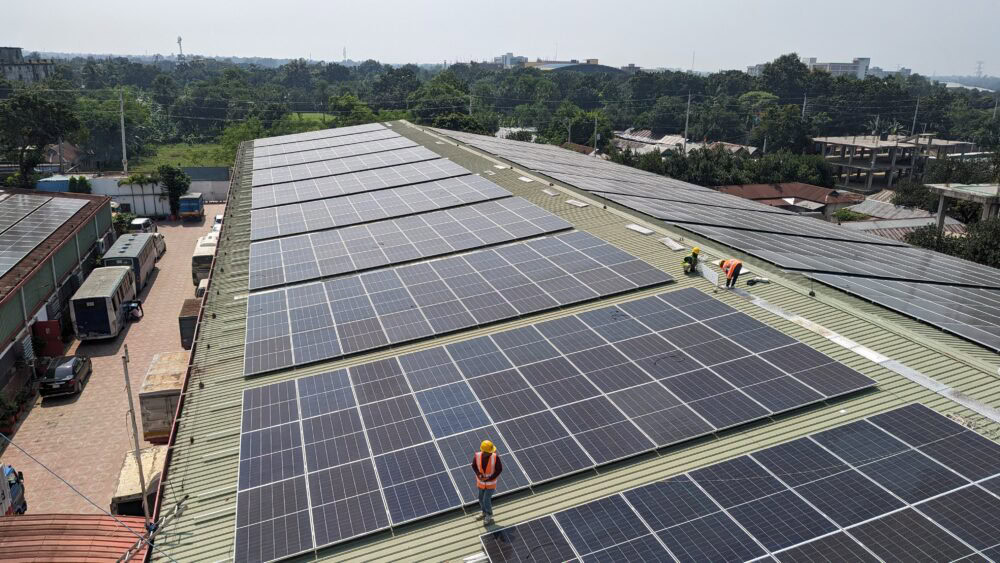
“Those companies work on very thin margins. There’s no financial ecosystem that’s going to finance that green transition. That’s where we step in,” says Willem. The business model is called ‘Decarbonization-as-a-Service’. The factory pays nothing upfront. One True Value finances the solar panels and keeps them on its own balance sheet. The factory then buys the electricity. This immediately delivers a twenty percent discount on the energy bill for the producers.
“If you invest one euro in our fund, we’ll re-invest it in a Bangladeshi solar panel company.”
Jaap-Jan Verboom, founder of Truvalu
Jaap-Jan sums it up briefly. “More sun for your money. If you invest one euro in our fund, we’ll re-invest it in a Bangladeshi solar panel company. There’s more sun there than here in The Netherlands. So globally speaking, you have more sun for your euro.”
The first investment has already been made. The fund invested in an ‘energy service company’ in Bangladesh. That company installs solar panels on the roofs of factories. This creates a diversified portfolio. The risk for investors decreases. Willem: “We’ve now made a first investment to show: this works. We’re going to scale up that investment further.”
From one-man operation to 10,000 employees
Jaap-Jan first came to Bangladesh 25 years ago. Back then he was still an IT entrepreneur. Seven years ago he seriously got to work in Bangladesh with his impact investment fund Truvalu. “There were people who said: you should come to Bangladesh. Well, off we went.”
He found a special country. Full of people and lots of activity. At the same time very informal with unclear regulations and considerable bureaucracy. “You’d say: not really a country that encourages you to go work there. But at the same time, this was also a place where impact investing was still completely unknown.”
Jaap-Jan quickly found a good team. People with a background in investment banking who wanted to work for impact. “A good team, in a difficult context and first mover. That’s also a recipe for success. So then we decided we were going to do it anyway.”
“Bangladesh knows very well how to make use of international trade. That’s also part of the success of the garment industry there.”
Willem Grimminck, founder of One To Watch
Truvalu’s biggest success story is in Bangladesh. “An entrepreneur who was still a one-man operation when we started with him. Now he has more than 10,000 people working for him and supplies all IKEAs worldwide,” says Jaap-Jan. How is that possible? “He’s a man with a dream and an inventiveness and a strength to build something that you find especially in Bangladesh. And then of course also the possibility to scale things up with so many people.”
Willem agrees. “I see that perseverance and that capacity to navigate through that local landscape. I think it also helps that it’s a somewhat smaller country. And I also see the parallels with the Netherlands. We’re also a small country with a lot of foreign business. Bangladesh knows very well how to make use of international trade.”
Energy becomes the biggest problem
Bangladesh is developing rapidly. Willem sketches the future. “In 2050 they’ll need four times as much energy as today. And right now the system is already creaking and squeaking everywhere. Because there’s simply too little energy supply.”
The grid is not good and not reliable. The production sector feels that hard. “When all those machines are running and the power goes out for just a moment, everything is chaos. It has to keep running continuously,” says Willem. The garment industry is the bellwether of that economy. Energy demand becomes the challenge.
Bangladesh used to have cheap gas. Just like the Netherlands once had. But that supply is running out. Now the country has to buy from India. Dirty and expensive carbon energy. “You see the margins of factories that export are getting thinner and thinner. And they’re already pretty slim due to those energy costs,” explains Willem. Switching to solar energy is a smart choice. The factories can save about twenty percent on their energy bill.
“In five years we’ll be a large fund. And Bangladesh becomes the springboard to grow to other production countries in Asia.”
Willem Grimminck, founder of One To Watch
But solar energy alone is not sufficient. Other technologies are also needed such as batteries and heat pumps to fully decarbonize. And then there’s that compliance story. Clothing brands have set targets to emit less in 2030 and 2050. Especially in Scope 3, the emissions in their production chain.
Willem works intensively with those brands. “We ask the clothing brands: what are your goals and how are you going to achieve them? What we can do in that, is narrow the gap between those goals and the reality in Bangladesh.” An average clothing company works with ten to fifty factories in Bangladesh. They have goals to reduce emissions by five to twenty percent. But how are you going to do it?
“We want to give access to capital. But we have to make sure that the risk of those investments remains as low as possible. How can we collaborate on that?” Willem wonders. The brands are certainly open to it. Only climate is still not always the highest priority. “They say they first have to make sure they buy clothing at the right price with the right quality and timing. So we have to make sure we relate the decarbonization story to the goals of that company.”
From Bangladesh to all of Asia
The fund uses blended finance. Willem: “We try to attract different categories of capital. Different classes depending on the risk profile of the investor. Where we have commercial investors with very little risk. And more donor-like investors who want to accept higher risk.”
Jaap-Jan gives a concrete example. “We have a partnership with the Swiss government in Bangladesh. Through the embassy there. We call that impact linked finance. A piece of subsidy goes to a business case where CO2 emissions are reduced. Private capital goes into that business case. But for the reduction, a bit of subsidy comes along. That makes the investment case more interesting. And then you see that one Swiss franc unlocks a whole series of commercial euros.”
The ambitions are big. Willem: “In five years we’ll be a large fund in Bangladesh with a large share of solar energy in the energy mix. But I also believe that Bangladesh becomes a springboard. To grow to other production countries in Asia. Vietnam, Indonesia, Cambodia, Sri Lanka. That’s where we want to roll out our business further.”
How will they achieve that? “First, just do it really well in Bangladesh. Make sure we really become the experts on implementing Decarbonization-as-a-Service. Build a good team. Put down a long-term vision. And go to other countries with that track record,” says Willem.
What entrepreneurs can learn
The time when you went to Bangladesh for cheap labor is over. But Jaap-Jan obviously clearly sees that this did happen. “Many of us still have the images of Rana Plaza in mind. Where a large garment factory caught fire and there were an enormous number of casualties. That happened in Bangladesh.”
Much has been done about compliance and improving conditions. “I won’t say that’s all behind us. But there are many entrepreneurs and companies you can work with where that’s no longer the case,” says Jaap-Jan. In a few decades, Bangladesh went from one of the poorest countries in the world to a middle-income country. “That economic strength to grow, you also find that in local enterprises. As entrepreneurs, you have to find local partners. Then there’s much to achieve.”
There are multiple sectors of interest. For export, of course, the garment industry. Especially when it comes to circularity and sustainability. At the same time, it’s also a large internal market with 170 million people on a very small piece of earth. “In agro-food you can therefore do an enormous amount. That’s now still a very informal market where hardly any food processing is done. There are many opportunities there,” says Jaap-Jan.
In addition, opportunities lie in the water and maritime sector. It’s a delta, just like the Netherlands. By the sea with a few large rivers that flow into the sea from the Himalayas. “A lot is already happening in the field of water and drinking water. And finally, it’s good to mention that there’s also a lot going on in IT. The expectation is that in the coming years that digital hub will be expanded further and further.”
For entrepreneurs, the lesson is clear. Look for local partners with ambitions and dreams. Look at strong sectors, such as water, circularity and energy. And don’t see Bangladesh as a cheap production site, but as a springboard to the rest of Asia.
Your next move
The story of Willem and Jaap-Jan shows that impact and profit can go hand in hand. Their approach is simple: identify a real problem, find local partners and create a business model that works for everyone. The factories save money. The brands meet their climate goals. And Bangladesh retains its position as a textile giant.
Want to explore international opportunities? Start by looking at countries where your expertise solves real problems. Find partners who know the local landscape. And remember: the best investments are the ones where everyone wins.